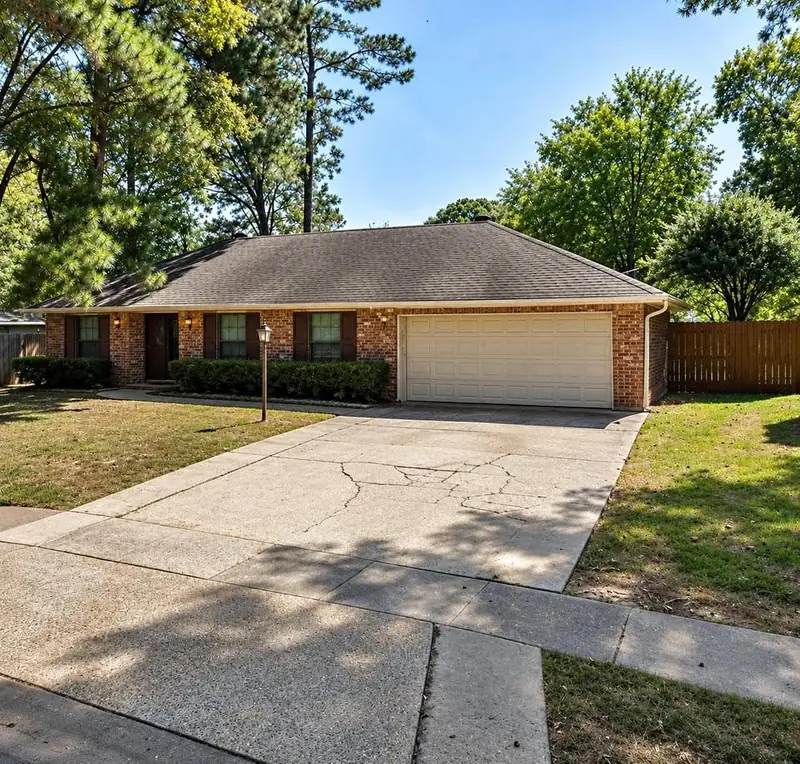
People ask what we will pay before we have seen the house. A fair answer is the pieces of the math, not a made-up price. Cash is not promised on every house. If the numbers do not work, we say so.
Call or text Charlie at (318) 714-4321 when you want us to look at a real house. The written offer, after that look, is the only number that counts.
The four pieces
We use the same four pieces on every house. The size of each piece changes with the house. We do not publish one percentage of value and apply it to every address.
After-repair value
After-repair value is what a buyer who wants to live in the house might pay once ordinary repairs are done. We look at recent sales of similar houses nearby. It is a working number, not an appraisal we hand you, and not a promise that the house will sell for that amount.
A repaired price and an as-is price are different. The as-is price is what the house is worth in the condition it sits in today. Most of the gap between those two numbers is repairs, time, and risk.
Repair costs
Repair cost is what it would take to go from the house as it sits to that repaired condition. A roof, an HVAC system, a foundation, a kitchen, or floors can each move the number. We walk the house. A photo is not enough to price repairs.
A house that needs little work has a small repair number. A house with foundation trouble has a large one. We do not use one repair allowance for every house in Shreveport, Bossier, or East Texas.
If you would rather repair it yourself and list it, that repair bill is yours. Our guide to selling a house that needs repairs walks through that choice.
Holding and closing costs
Someone pays the carrying costs while work is done and until a buyer closes. That includes property taxes, insurance, utilities, interest or the cost of cash tied up in the house, and basic upkeep. Closing adds title fees and whatever else the title company puts on the statement.
Those costs are part of a house we buy and repair. They are also part of a listing, in a different shape: you pay them while the house is on the market. The Louisiana seller closing costs guide explains the usual lines on a Louisiana sale. It is not a bill, and it does not set the costs for a house in Texas.
Our margin
What is left has to cover the work, the chance that repairs cost more than we thought, and the chance that the resale takes longer. That is our margin. It is how the purchase makes sense for us. It is not a fee we add on top of a retail price, and it is not a commission charged to you.
When we buy, we charge sellers no fee and no commission. Who pays which closing costs is written in the offer. We do not promise to pay all of them. You see that paper before you agree, and you can say no.
We do not use one margin for every house. A clean house with a clear title is not the same purchase as a house with a bad foundation, a title question, or a long list of repairs.
Want a cash offer, or to have us take over the payments? Call or text Charlie at (318) 714-4321, or Get My Cash Offer. Cash is not promised on every house. No fee, no obligation.
What this page will not tell you
- A dollar amount for your house. We look first.
- A guaranteed percentage of after-repair value. Houses are not that alike.
- A promised number of days to close. You pick a date, and the title company and any loan payoff set the pace.
- That cash is available on every house. Sometimes the written choice is cash. Sometimes it is taking over the payments. Sometimes we cannot buy it.
Get two or three written offers before you sign with anyone, including us. The checklist is in how to compare cash home buyers.
Compare a cash sale with listing
The calculator uses numbers you type. It does not look up your house, and it does not know what we would pay.
- Estimated value as-is. What you think the house would sell for today, without repairs, to a regular buyer. We show it back to you. We do not use it as an offer.
- List price. What you would ask if you listed. The calculator treats that number as the sale price.
- Repair cost before listing. What you would spend to get the house ready to show.
- Agent commission %. Your assumption, as a percent of the list price. Six is a common starting point. Change it.
- Seller closing costs %. Your assumption for title fees and other seller costs, as a percent of the list price.
- Months to sell. How long you think the repair-and-list path would take.
- Monthly holding cost. Mortgage, taxes, insurance, utilities, and upkeep for each of those months.
- Cash offer. A number you want to test. It is not our offer unless we put it in writing after we see the house.
Cash sale or listing
Type your own numbers. This is an estimate only, not an offer. Use 0 if a cost does not apply. The as-is value can be left blank.
A loan payoff comes out of either path
If you still owe a mortgage, the title company pays it from the sale, whether you sell to us or to a buyer from a listing. The calculator does not subtract that payoff. If you want a picture of cash in your pocket, subtract what you owe from either net. We do not know the payoff until you share a statement.
A higher list price is not the same thing as a higher net. Repairs, commission, closing costs, and the months you carry the house all come off the listing side. A cash sale skips the repairs, the showings, and the commission. The headline price is often lower because those costs and that risk moved to the buyer.
If the listing net is higher on your numbers, and you can carry the repairs and the wait, listing can be the better path. If the two nets are close once you count time and repairs, a cash sale can make sense even though the price on the first line is lower. Neither result is what we will pay.
Call or text Charlie at (318) 714-4321, or send the form, and we will look at the house you actually have.
The calculator above asks for a cash number so you can compare two nets. A separate page, the listing-cost estimate, does not ask for a cash offer and does not name our price. It only adds up listing costs from numbers you type.
Updated November 11, 2026